
Studio Setup
Glorious Analog Clutter

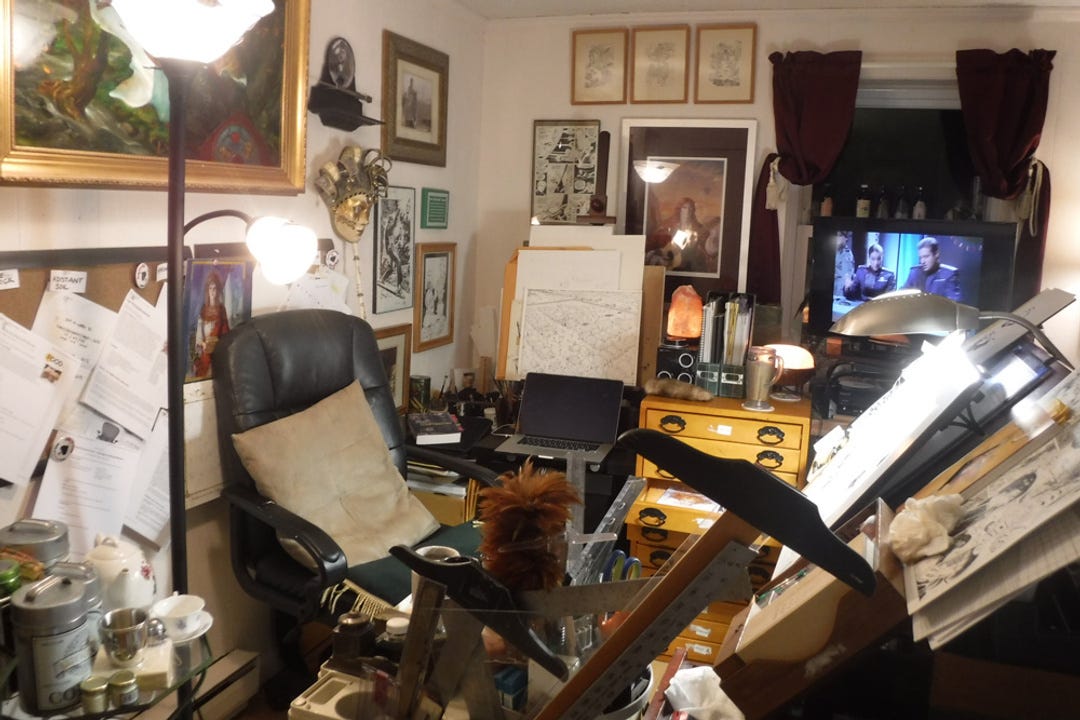
I’m lucky to have two rooms in my house for studio use, but as an analog artist my space is always kind of cluttered and crowded with the many different projects I am working on. I have to make good, organized use of my space or it falls into chaos quickly. A digital artist might get away with minimalism, but I have many different types of paints, pens, pencils, etc, and I need to take good care of them and have them where I can easily get to them. I can go a year or more without using a tool, then drive myself crazy trying to find it when I need it.
Also, I move everything around every few years or so, constantly looking for the best use of the space. Between the time I wrote this and the time I posted this here, I’ve changed it again. But all the tools are the same.
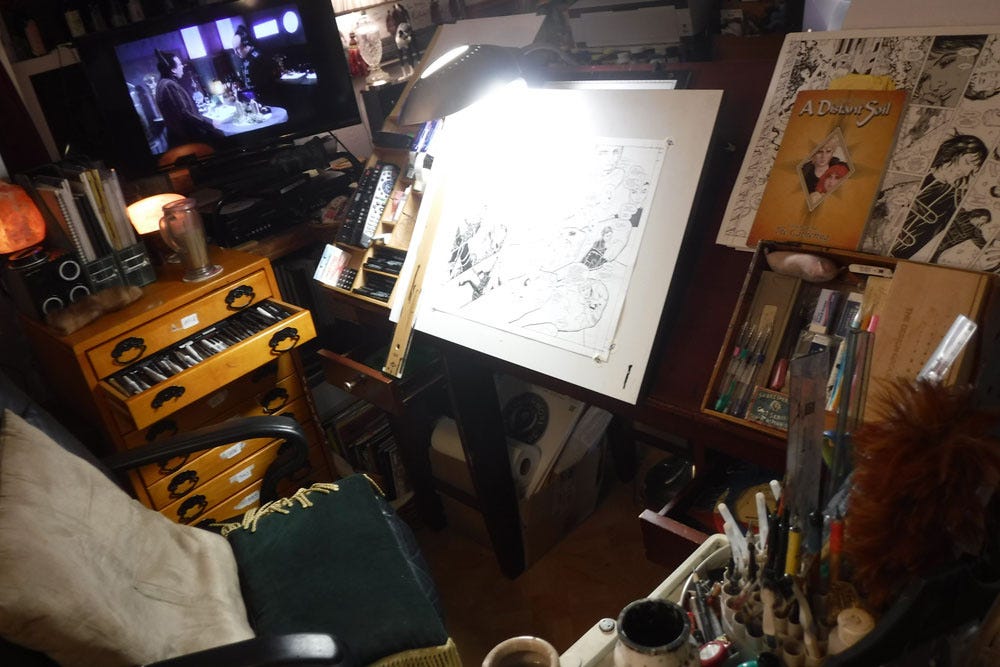
As you can see from these pics, I have many t-squares, rulers, pens, paints at the ready, in a u-shaped work area where I can easily access them simply by turning from one side to the next.
My drawing board, and the map chest cabinet in this pic were purchased from Home Decorators Collection, and I got a much better deal on them than if I were to buy them as art supplies. I think that chest only cost about $140. The big drawing board, which is solid wood stained to look like mahogany, didn’t cost much more.
The drawback with the drawing board is it has a lip at the bottom that doesn’t let me run my t-square along the edge, and I quickly learned the far right and left edges were slightly warped. So I couldn’t get a clean line. The board was also not adjustable to a high enough angle for my liking. But I really like the board’s breadth and the built-in drawers. So I simply set a smaller portable board on top and underneath it I leave my flat Huion lightbox. All I have to do to switch between jobs is lift the smaller board off. The lip on the big drawing board then lets my table hold boxes for tools. I’ve never had any serious problem with anything falling, either.
I can keep two jobs on the table, one sitting right on top of the other at a time, because the white laminate board never sits flat on the lightbox.
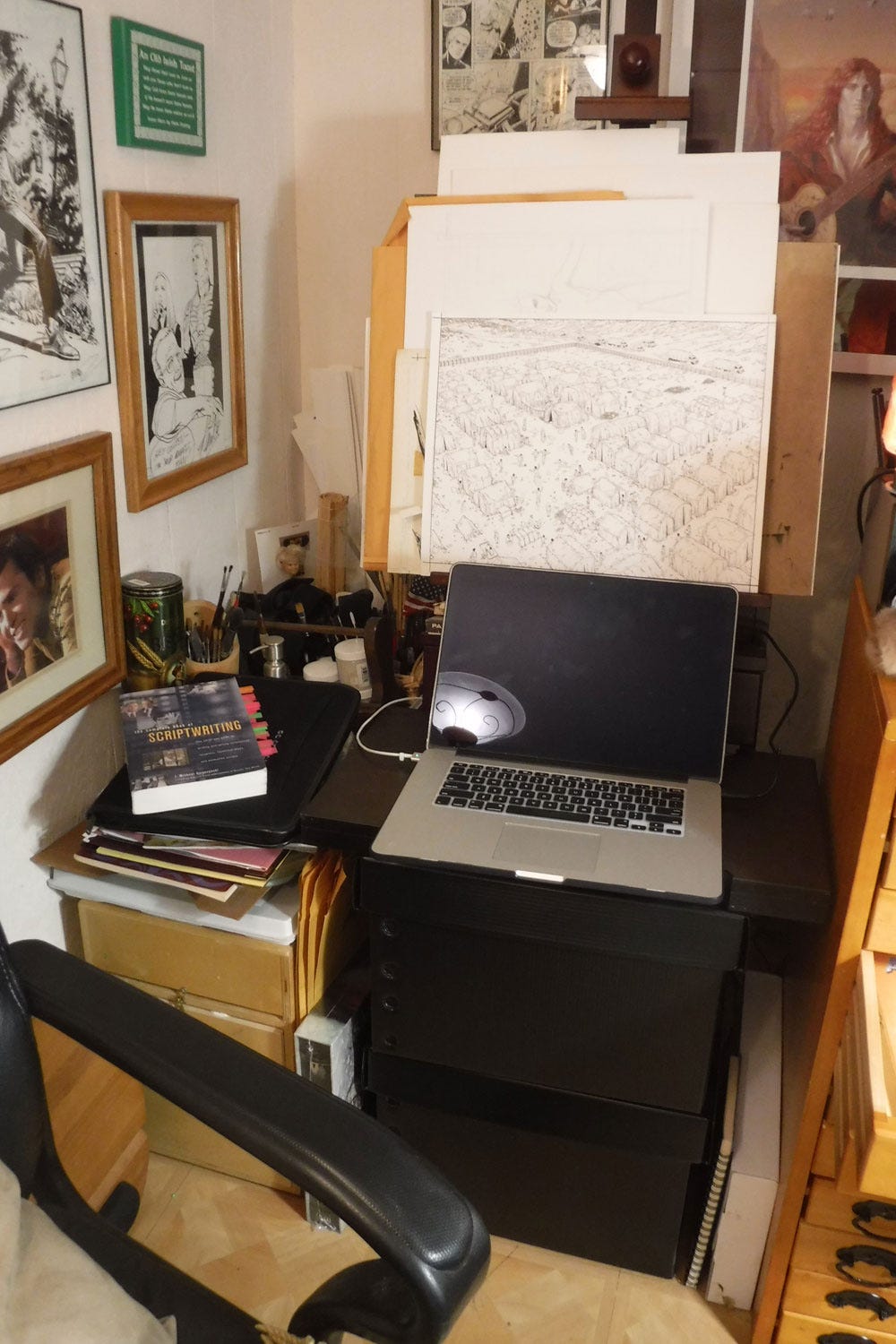
At the far left there is a long wooden box with two drawers for my Genesis oil paints, an easel, lots of tools sitting on, in, and around all that, and a makeshift mini-desk for my laptop right on top of these two sturdy comic boxes with comics I need for reference. Nothing fancy, but it gets the job done.
Genesis paints aren’t even made any more. They were billed as “heat set oils”, but they weren’t oils at all. They were acrylics that only dried at 250 degrees. They had their uses, and they really did look like oil. I bought the entire set up years ago, only did about ten paintings with it, but I still have plenty left, and the storage chest was worth it for its own sake.
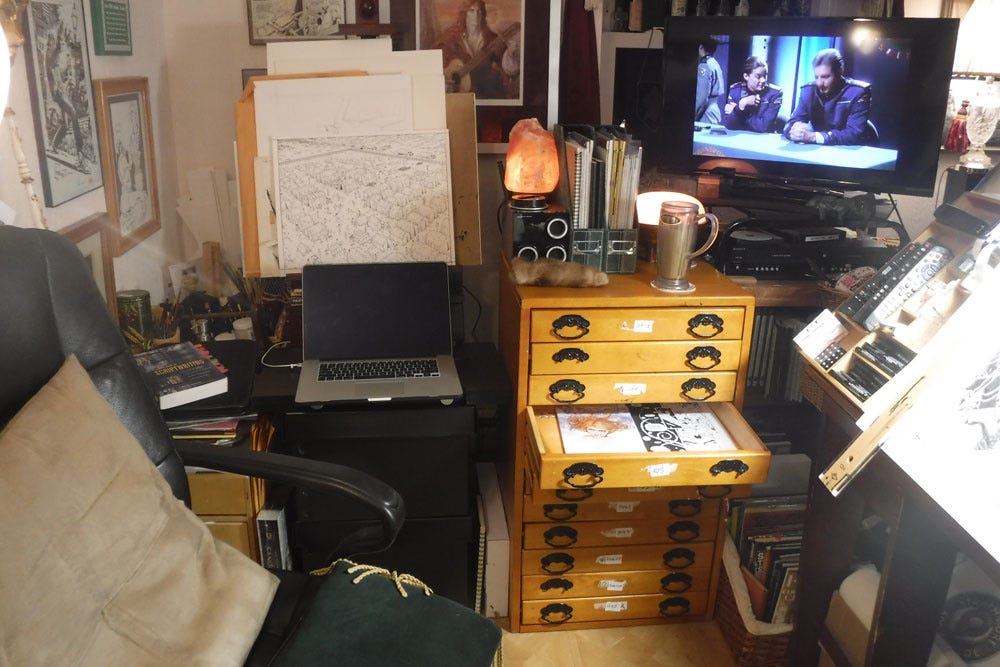
Another look at my space. There’s a Porsche iPod dock which was a gift from J Michael Straczynski, and there’s Babylon 5 playing on the tv, and there’s Joe’s book on screenwriting which I’m studying.
That iPid dock went home to Jesus awhile back, but it lasted well over a decade.
You can see how convenient this set up is. The map chest acts not just as storage, but as extended desk space. Each drawer has tools or different assignments in it. When I move an assignment up in priority, I pull the drawer out and move it up for easier access. Then I leave the draw open so I can see reference, art, or whatever I need for that job. A major job will have a couple of drawers dedicated to it, and there are usually several folders in those deep green units at the top, and behind that in an accordian folder as well. There is a lot crammed in this little space.
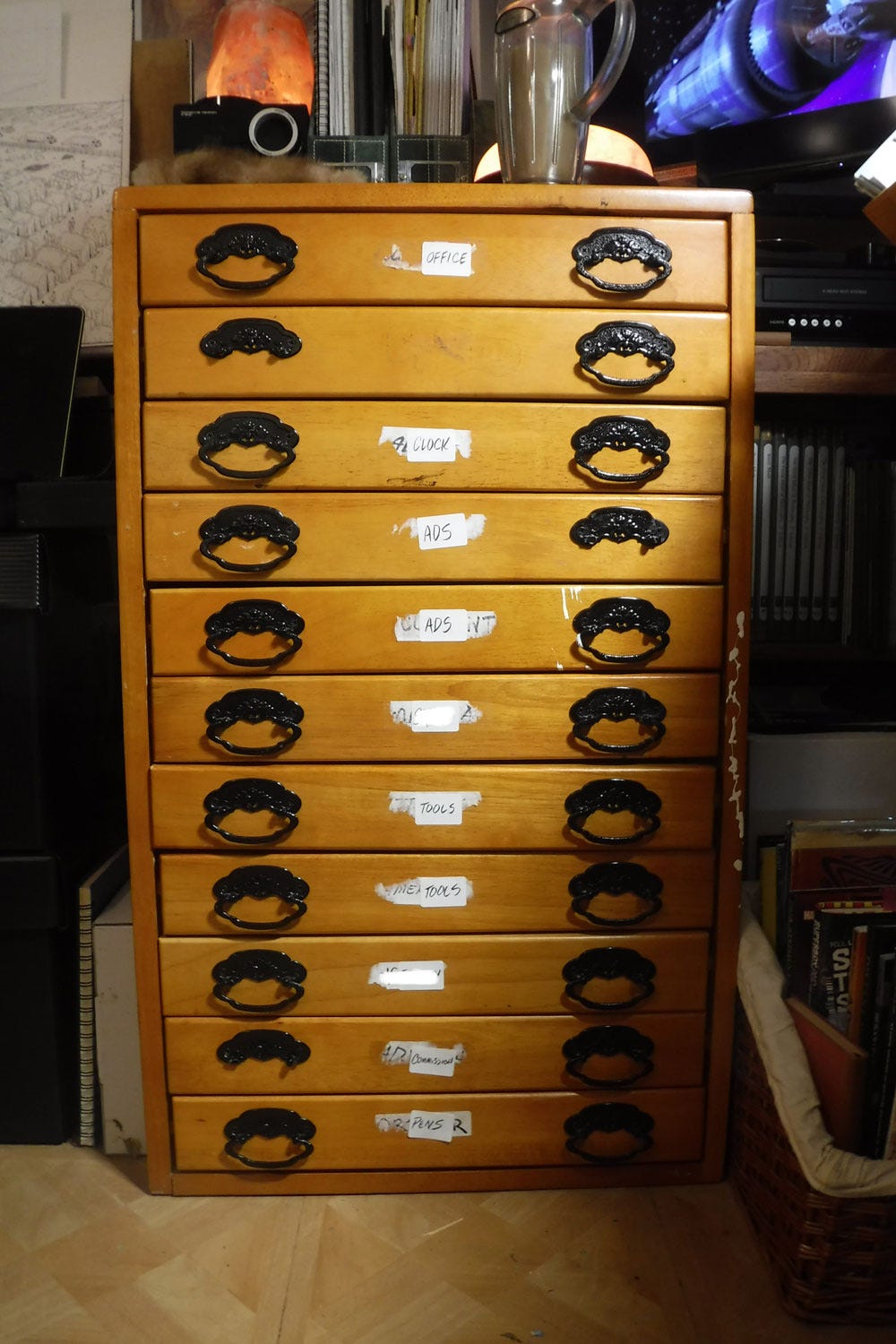
Here’s a look at that map chest. One of the best deals I ever made. Some of the titles of projects I’m on are whited out. There is also white paint splashed on the thing which I’ve never managed to get out. It also spilled all over a leather hardcover of those Batman stories by Frank Miller DC put out a long time ago. That was a bad day.
I’m always ripping off old labels and putting new ones on. Looks a little grubby.
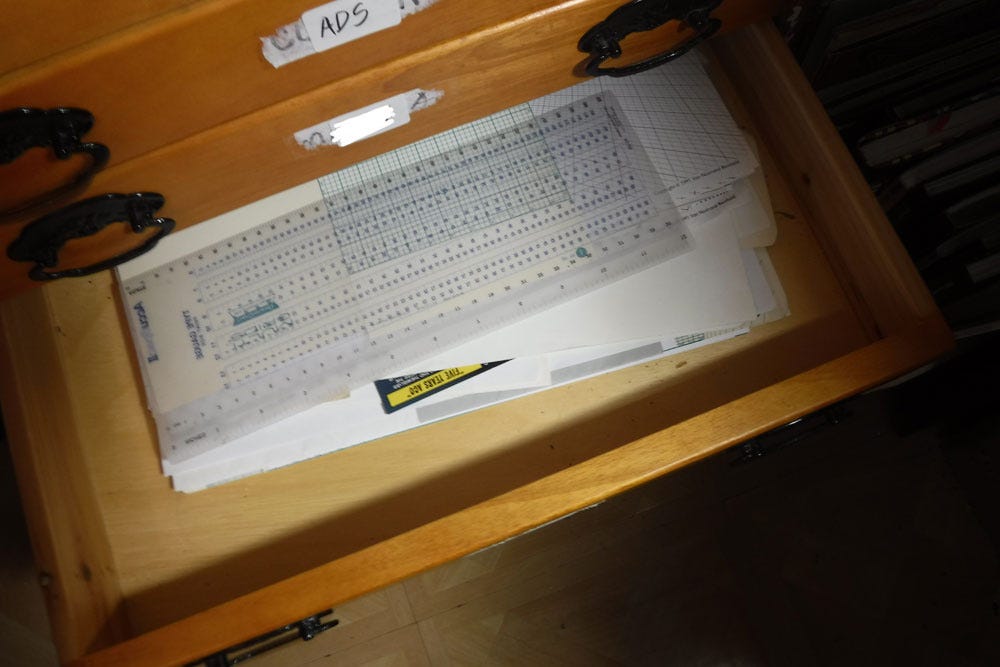
As you can see, there are drawers just for tools, and drawers for assignments in the unit. I notice a lot of artists use drawers like this just for storage. They pull everything out, then cram it all back in. I recommend you use the unit as an extended desk. When I need something more often, I move the drawer to the top of the stack.
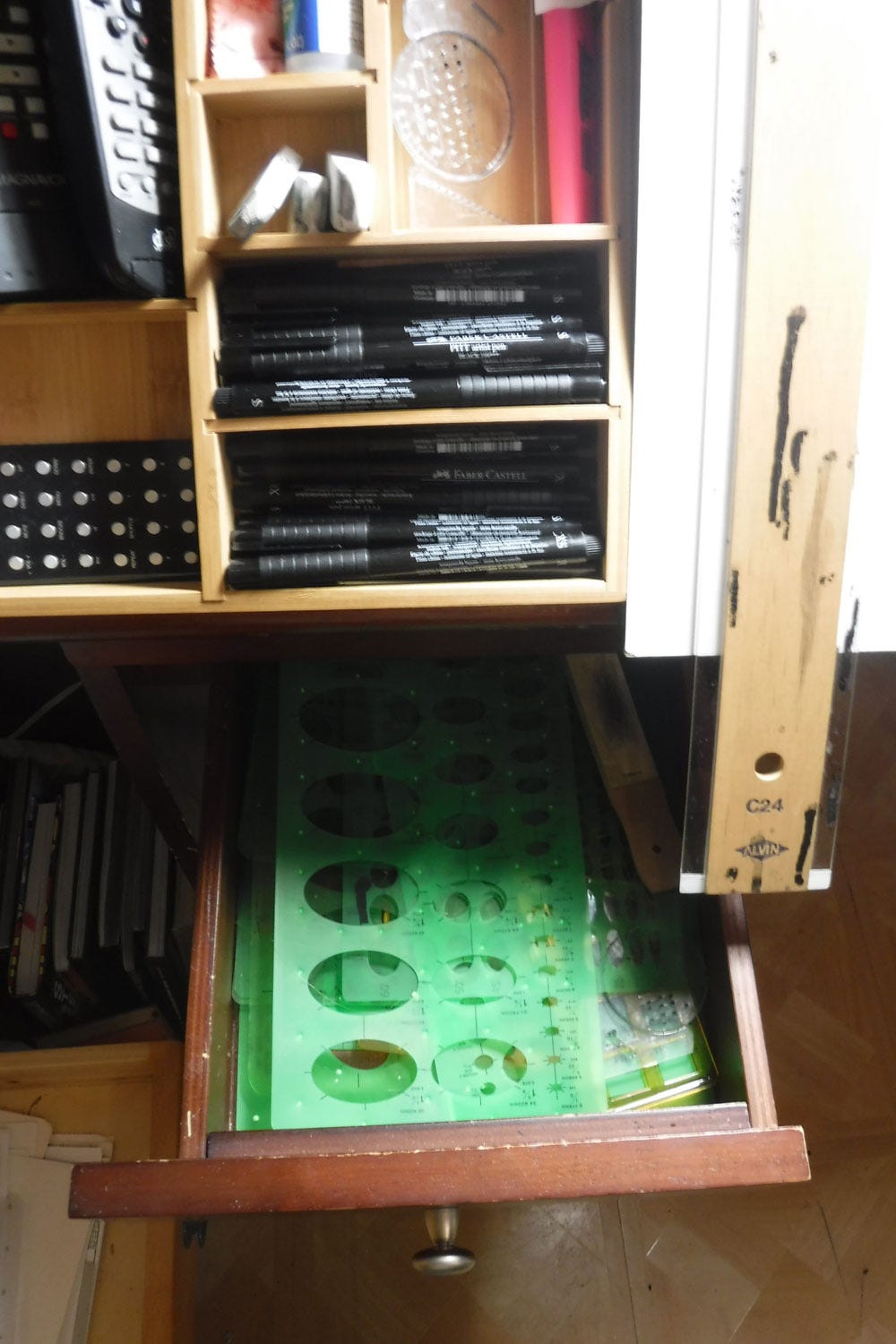
My drawing board, the one I got cheaply from Home Decorators Collection, has two drawers, one on each side. This left hand drawer has circle and oval templates. I use this a lot. Since the drawer to my left is the most easily accessible drawer, the tools I use most are in here. Also, you can see how a bamboo kitchen utensil storage tray is perched on the lip. This narrow tray sits comfortably here, but if you want to secure it, use museum putty or two-sided tape. In the many years I’ve had stuff perched here, I think I’ve had two accidents without using anything to secure the tray.
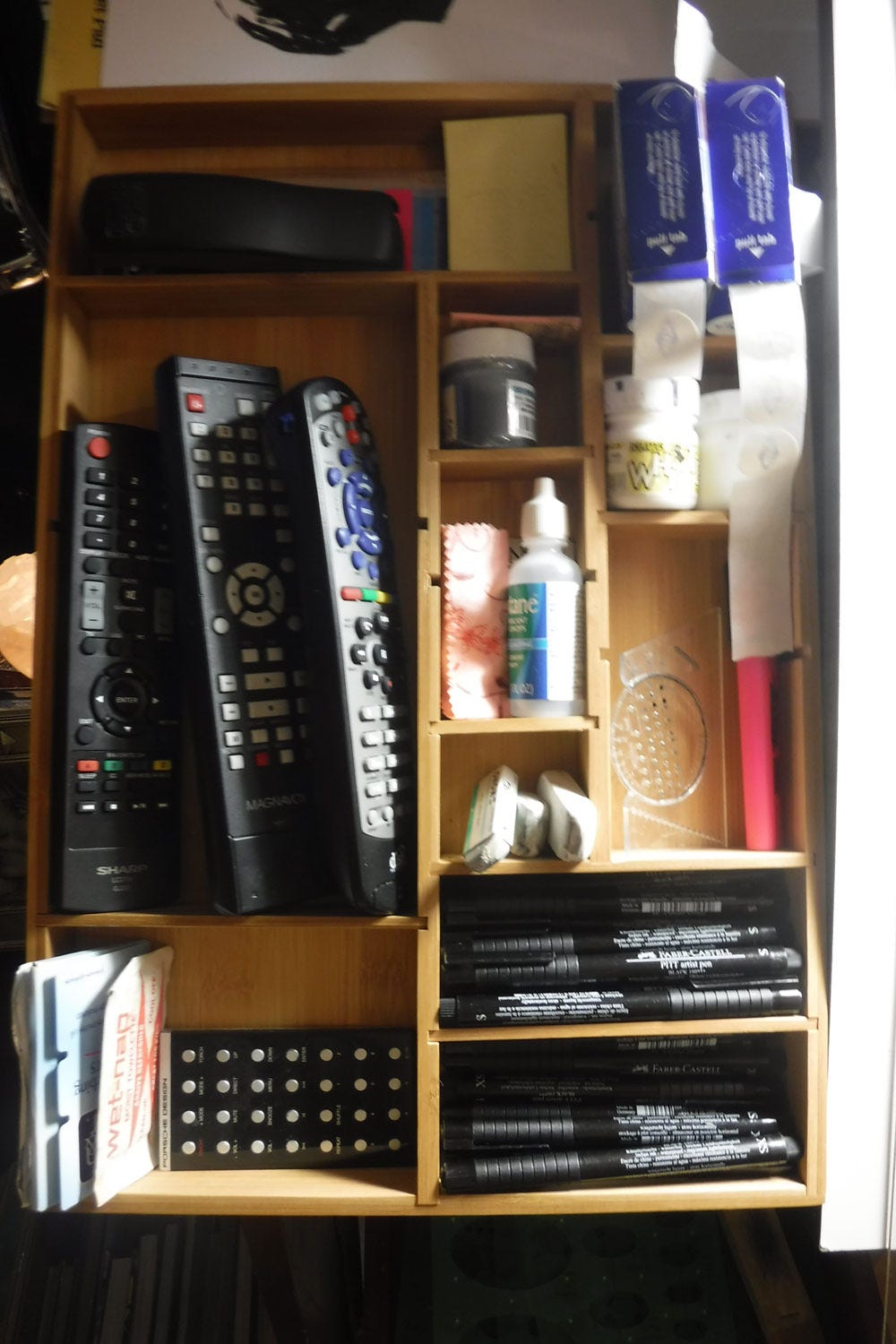
Another look at that tray, which I blogged about the other day. I love how I can get my favorite pens to lie in there perfectly flat and ready to use. There’s also an ancient pair of Ames Lettering Guides, and my remotes, which I will lose if I don’t put them in their proper spots!
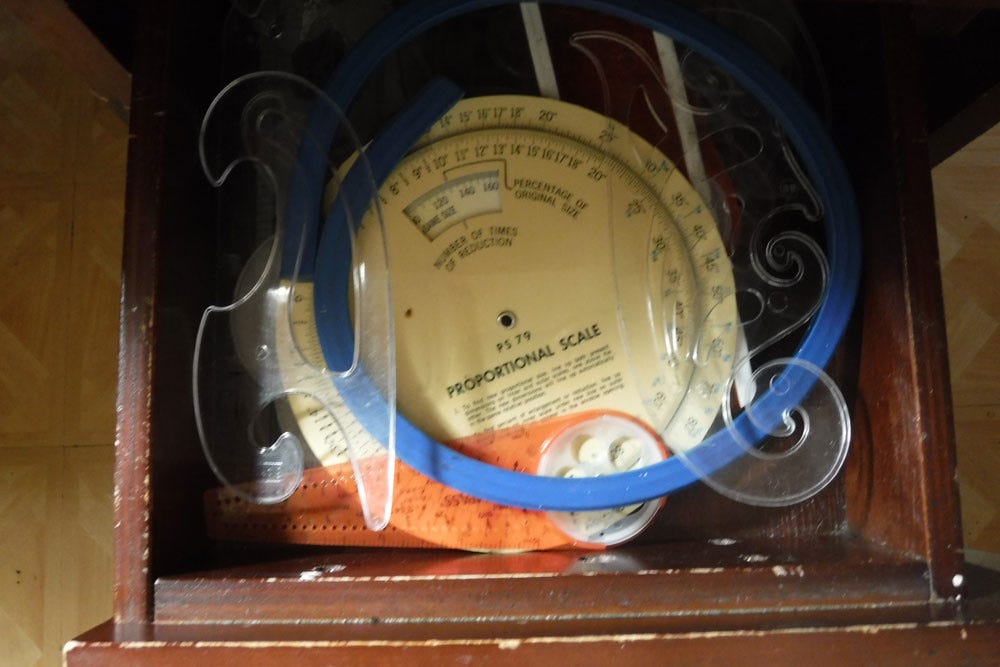
In the right hand drawer, French curves, a proportion scale, and a flexible curve. Was really surprised to learn how many young artists don’t have a clue how to use this stuff.
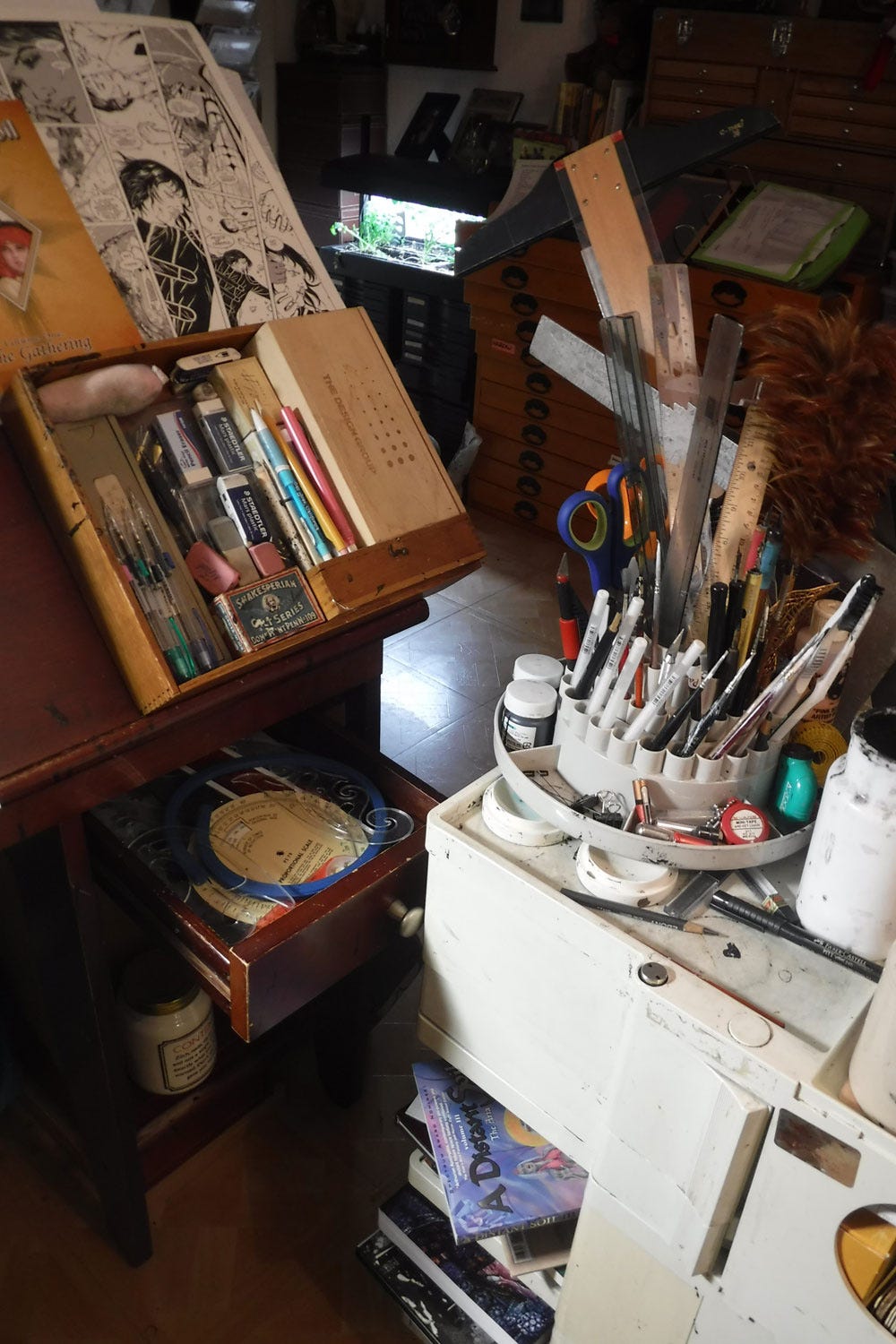
Lately I stopped using these trays directly on the desk, because I figured out that by using the main drawing board as a table and then perching a smaller tilting board on top, I actually get a lot more storage space out of it.
This is the view at my right hand, with the drawer to my drawing board open, and the taboret, which is one of the coolest things I own, and worth a small fortune. On the lip of my drawing board, another kitchen tray for organizing pencils and pencil-related tools. Some of the boxes in there come from the studio of cartoonist Marie Severin. The little wooden box holds her original X-Acto knives and blades, which I still use.
Many of my t-squares and triangles come from Marie, Frank Kelly Freas, and the studio of Nick Cardy. The little carousel on my taboret was very inexpensive, but you can see how handy it is! You can find that on Amazon.
The taboret is one of the only pieces of furniture in my entire studio which was actually intended for artists. Everything else was marketed to crafters and as home decor. My flat files, which match the map chest you already saw, was from the same company and, again, was sold as a home decor map chest.
It’s always a good idea to look for artist furniture under different names like map chest instead of flat files, architect’s desk, crafter table, etc. You may find a better deal that way.
On top of the big flat file toward the back of the photo is a wooden tool chest which I got for a song because it was the floor model. I store paints in it.
I also leave the top drawer of the flat file open and out, again extending my available desk space. I keep my daily planner file perched on it.
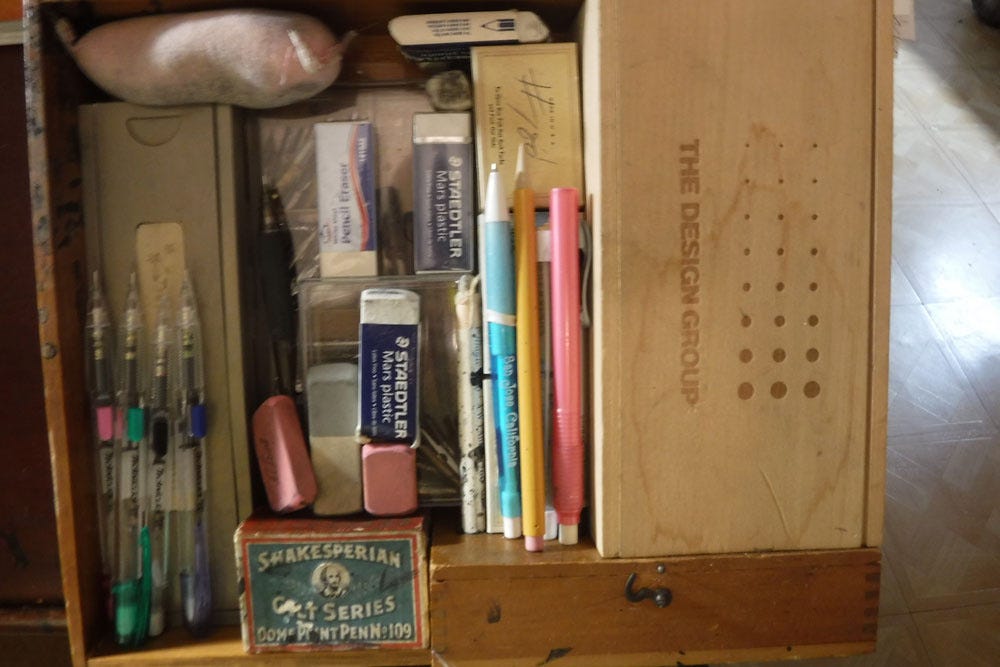
Another look at that box perched on my drawing board. Some of the crowquill pen tips I use for inking, as you can see from the box shown here, are 50-100 years old.
I use many kinds of erasers for different effects, including a sand eraser which can rub out ink if used carefully, and the dots on tone sheets to get nifty airbrush-like effects.
The puffy looking pink thing at the top is a kind of old fashioned graphite duster.
Each one of the boxes there has different pencil tools or types of pen points in it. The stuff I use less often gets pushed to the bottom.
Both of the kitchen trays that sit on the lip of the drawing board is solid enough for me to perch art reference and tools on top, again extending my work space.
I’m afraid Home Decorators Collection doesn’t really carry this furniture anymore, which is a shame, as Martha Stewart had a home crafters collection with some really cool stuff at good prices. But you might be able to find some deals on the secondary market. I’m not even sure they’re in business anymore. Just did a search and kept being directed to Lowe’s. Definitely not the same company, but whatevs.
Thanks for sharing! I’m always curious of an artist’s set up. I dream of having a setup like this. I’ve lived in NYC apartments my whole life. When I tried to be a professional artist in the 1990’s, I was still living with my parents and had an IKEA drafting table and shelving unit I was obsessed with. When I moved out of my parents into another apartment, I had even less room. By the time my kids came around, a career change had to happen so everything was gifted or sold. Now the kids are adults, I’ve resolved to drawing more, even if it’s a hobby at this stage. I’m in a new apartment with a new relationship, and I’m still only relegated to a corner of the living room. I’ve learned to work digitally, sometimes implementing a hybrid system. Thanks for showing me something to strive for.
Brings back many fond memories. In my basement I have a large flat file with large flat agfa boxes as drawers. Inside one of these drawers is a collection of all my old tools; ruling pens, compasses, French curves, t-squares, point/pica rulers, proportion wheels, an well balanced x-acto, a cork semi sphere loaded with used blade, sand to top it all off—sheets of press-on lettering and zip tone. When I was teaching college I brought these in as a museum exhibit to touch on where we as commercial artists come from, and how old tools where programed into modern software. (a student asked me “why is the icon for the crop tool shaped like that?”)
I'm completely digital now. But I I feel like learning to master these physical tools somehow made me a better illustrator. More deliberate somehow. I still get a thrill remembering spending 40 hrs on an illustration and then having to rip it from an illustration board to be mounted on a sci-tech scanner.