
Royalties
Roll in the dough

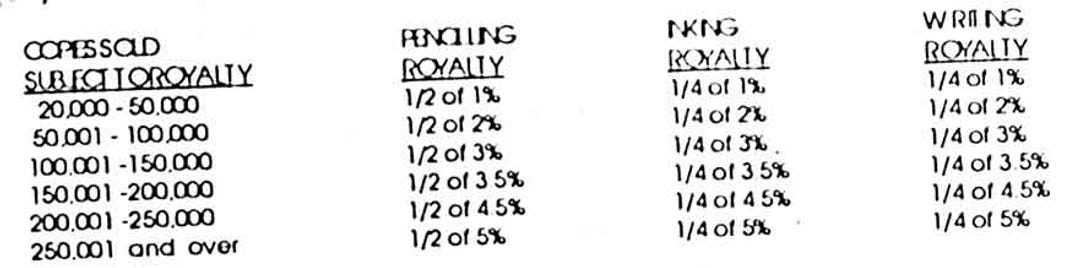
While I’m committed to giving you as much in depth industry blogging as I can here, I also have to be careful about illegally or unethically revealing proprietary information. Since this publisher went under nearly 30 years ago, no harm done putting this up here now.
This is the 1980’s era royalty structure from a well-known indie or “ground level” publishing company. I’m not going to name them because I don’t know what rights were transferred when they went under or sold out. And I’m not entirely certain if it was a bankruptcy or they just gave up.
A lot of people thought creators were getting rich back in the day with these indies, what with “creator rights” and “royalties”. Wow!
Creators didn’t get royalties before, and you got to keep your rights now!
How revolutionary.
But have a look at those numbers. First off, royalties didn’t even kick in unless your book sold over 20,000 copies. More than most comics sell today. And if your comic sold for $1.25, then as the penciler you got a whopping 1/2 of 1% of cover. That’s .00625. If you sold 50,000 copies, that’s all of $325.
Now, that’s about $700-$900 in today’s money. Not bad as a bonus, but you’re not rolling in it. Only a handful of books at this publisher ever reached the 100,000 mark, and in the brief time I worked there, nothing I did earned a penny in royalties. That means that some well-known books weren’t cracking the 20,000 sales mark.
This royalty structure is not that far off of market royalty structures for a lot of comics companies today, except that the royalties generally do not increase percentage-wise as the books sell more copies. You see how the royalty could crank up to 1/2 of 5% from 1/2 of 1% depending on sales. Except I don’t think anyone ever hit those sales marks at this company.
Book publishers usually have graduated royalty increases based on sales like this. And I’m sure a lot of creators looked at that big number and assumed book sales must hit that number at some point. But they really didn’t. And there was no way to know what sales were unless the book had newsstand distribution and printed one of those annual sales disclosure statements, which most indies did not. Pre-internet, there were no sales charts with sales estimates either; not that they are particularly accurate, but whatevs.
As I recall, my page rate at this company was about $60, or around $120-$150 per page in today’s money. The $60 page rate is about what some indie publishers are paying now. It’s terrible money: you can make more money at McDonald’s. There’s been no effective increase in industry page rates in decades.
In the You Can’t Be Subtle department, someone wisely advised me that no matter what you post, as long as its a blind item people’s minds are going to run all over the place until it hits the identity of someone they know, so I danced around the subject of this post as carefully as I could.
This was actually a project I WORKED ON and got into a twitter storm with other creators about the wisdom of doing social justice projects to promote women that don’t actually pay women anything. It was kinda ugly (back when this actually happened around 2015). But whatever. I roll my eyes heavenward...Anyway...
This has long been my beef with indie publishers, using declarations of being anti-The Man, and Super Progressive to excuse poor business practices and exploitative behaviors.
This has not changed one iota since I’ve been in comics.
Being anti-The Man to avoid paying out staff is among the most The man things anyone could do
Many moons ago, I had worked with a number of comic companies from a business consulting perspective (before creating my own very indie publisher side hustle for a short while). With the clients at the time I was advocating for a stable page rate and expanded royalty structure as part of creator retention. I was also arguing that comics are not a self contained product but rather the testing ground for IP that could also expand into other medium, that comics were at the core of the value to maintain stickiness to the IP, and it was through these other licences that the page rates and creator royalties should be paid and maintained at “current rates” and continue to grow. I was applauded for a few months when a couple “top talent” creators were retained through such a contract. And then my consulting arrangement wasn’t extended once they realized it was just cheaper to outsource to Brazil and the Philippines and in many cases avoid royalties all together.