
Adjusted For Inflation
Yours Truly. In the Middle

Adjusted For Inflation

This is a public post, because transparency and keeping it real is my motto.
Awhile back, I wrote an article about how I’d managed to navigate the rough waters of the comics industry on low income, having been poor or lower middle class for the majority of my career.
I was wrong.
I was not poor or lower middle class for the majority of my career.
Because the general metric for middle class is based on a household with a family of four and those were the charts I was looking at. For most of my career, I was living in a single person household. The middle class metric for a single household is much lower than the middle class metric for a family household.
So, I based my assessment on the 4 person household metric even for years when I was living in a single person household. Sometimes the single person middle class rate is full half of what the four person household rate is. (Yeah, I know this paragraph is a bit redundant, just hammering it in there for emphasis.)
Duh.
Here’s the reality: I was poor for the first ten years of my career, for three years in the 1990’s, for three years in the 2000’s, and one year in the 2020’s.
The rest of the time I was a perfectly normal middle class, with random years at meh lower middle class. For some periods I danced in the upper middle class range. I even tickled wealthy for a few years there, especially when I was self publishing, which is why even though I was pretty broke in 1998 I was able to skate by.
Because I’d made a lot of money in 1994.
We often discuss the poor pay and treatment comic creators get. We share the sad page rates, the low royalties, the lack of benefits.
But it’s important to add the perspectives of time, place, and circumstance and keep it honest and frank at all times when discussing these matters.
I loathe people who exaggerate their success stories because they are afraid of looking like losers, shoring up false beliefs about the art life, and encouraging Keeping Up the Joneses bullshit while not being able to pay their HOA bills year after year.
It’s not a crime not to write a bestseller every time you try. You’re not Stephen King. It’s OK.
So.
I made about $20,000 around 2000, which isn’t much. But $20,000 in the year 2000 is the equivalent of:
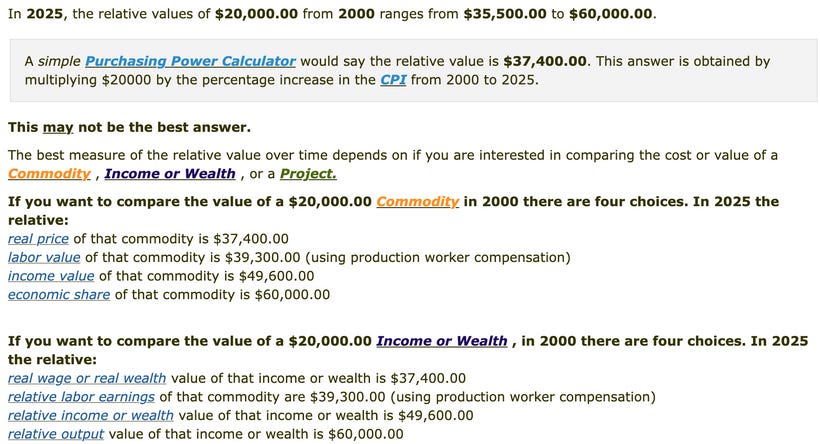
Most comic book creators can’t make $20,000 even now.
$20,000 was middle class income for a single household, especially if you’re not living in a place like New York City. I was only paying $450 a month in mortgage. It wasn’t fun money. It wasn’t get ahead money. But it wasn’t poor.
Years earlier when I was self publishing, my gross income was about $80,000. Which, again, doesn’t sound like all that much in 2026. When my other self publishing buddies were becoming millionaires, I felt like smol beans.
But $80,000 in 1994 is now:
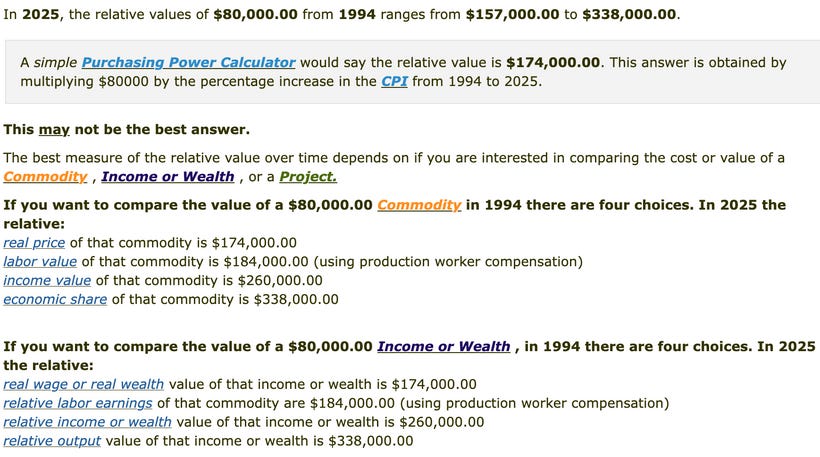
That’s wealthy for a single person in 1994.
I used to get a lot of crap from people for being a rich and showy cartoonist, and I simply didn’t understand it. I didn’t feel rich. I just felt like someone who was playing catch up from ten years of being poor. It baffled me that people who kicked me when I was down were kicking me when I was up.
Life’s funny like that.
Also, my expenses were high, I was self publishing after all. But even after expenses, I was doing well, had money to save, and money to weather the downfall of the comics industry when the hammer came down in 1996.
Ten years later, I still hadn’t recovered these glorious income highs, but I did hit the $50,000 range.
Thanks, Reign of the Zodiac and Book of Lost Souls!
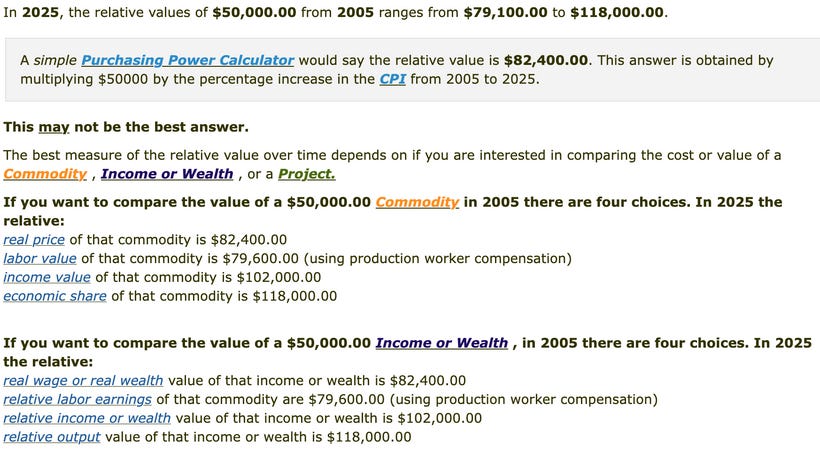
Not rich, not poor, but solidly middle class for a single person, debt free, and doing well for a cartoonist. I even had a few luxuries and went to riding school for awhile. I was able to save money. When I became ill with an undiagnosed auto-immune disease in the coming years, I paid the bills.
Which wasn’t fun, lemme tell ya.
I’ve never been in a situation where I could not pay my bills, and never borrowed money from my parents (but boy, did the household payment skate for a protracted, scary period, lemme tell ya some more). I took out a loan or three (or five) from friends (thanks, Joe) all of which I paid back in full which is more than I can say for people who took out loans from me when I was flush.
“Harold” and “Gladys” and “Sherman”, hi, bet you’re reading this.
And still lying about it all.
Whatever.
But...every year you are poor costs so, so much over the long haul. For the first decade of my career, I could not save or invest. In the years my income tanked, my savings and investments paid for the bad years, and there went the savings and investments.
It is very, very difficult to make up the time cost of lost investment. VERY difficult. Most creators never save or invest at all.
I didn’t raise crowdfunding for my health issues as many creators who are far more well-known than me, have far higher incomes, and who enjoy a broad circle of rich friends to finance them did. You never know what is going on behind the scenes that pushes people to make those choices. They may look successful on the surface and underneath it’s all iceberg.
But I’m saddened at the long list of creators who can’t meet their needs. While I know some of them simply didn’t want to dip into their own resources to cover expenses, most simply had no resources.
And that is scary. The scary truth of the freelancer life.
When my income went up again around 2010, I saved that money and financed a return to A Distant Soil as well as a two-volume restoration, which absolutely gutted my bank account for awhile. Even though A Distant Soil is in the black again, I get agida at the thought of carving out the time it needs. I worry it will eat up my savings again.
This concern is not really valid. It’s just a vague fear.
Because freelancer life.
I had a really (really) bad year in 2023 for the obvious reason that I had severe health issues and could not work. The bills got paid, the bank account drained. That is how it goes. I’ve had good to excellent years over the last decade, and only one bad year. So, I’m not going to complain too much.
But anyone who understands money understands that you are unlikely to recover from year after year after year of low income - which is what most comic creators have. As someone who has had years of low income, years of middle class income, and years of income spikes, I’m a bit more likely to work things out, and far more likely than some to be prudent with my money.
And I wish very much I knew as much about money management in 1989 as I do now.
Back in the day, my mortgage was only $450 and my health insurance was only $32.
You read that right.
Even into the 2000’s, my health insurance was only about $132.
Now I pay $1100 a month. This far exceeds the rate of inflation. And I get no benefits I don’t pay for because I’m a freelancer.
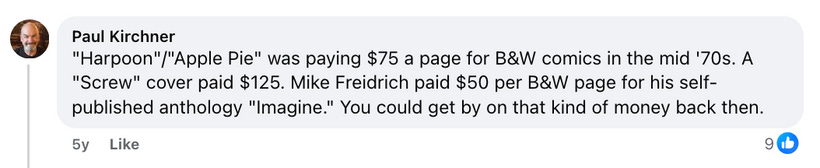
This was an interesting discussion on Facebook awhile back.
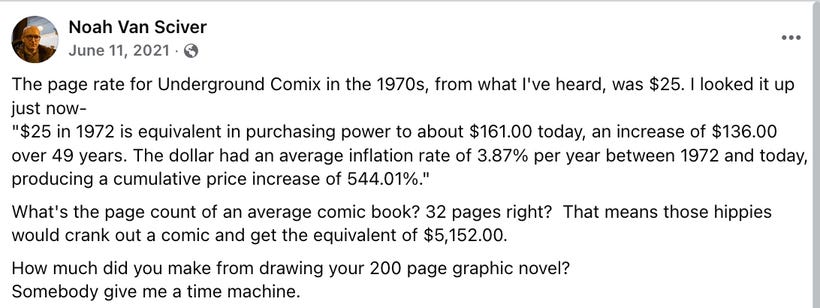
I was paid $20 a page for working in fanzines back in the 1970’s, which means I was getting paid more than people working in indies are paid now. And while I was getting about $1 per hour at times while working on A Distant Soil at my first (comics) publisher (which only adjusts for inflation to about $3-$8 an hour now, Jeez) my 1980’s page rates in mainstream comics translate to about the same money I get now.
Which means I haven’t had a page rate raise in 40 years.
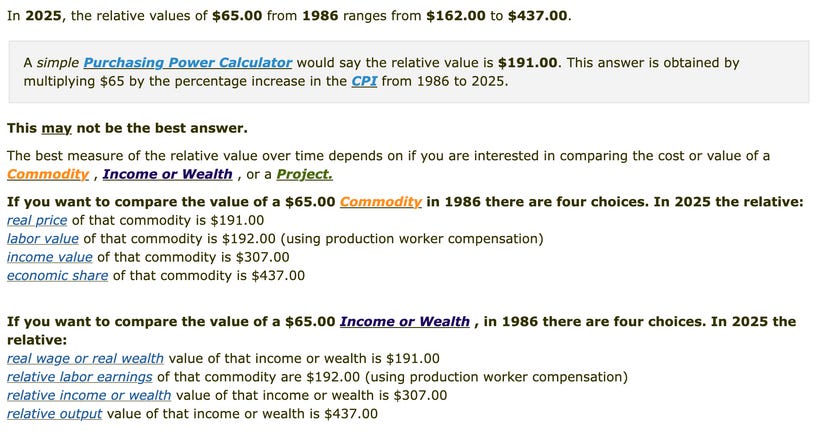

Now, I do make significantly more money than I made 25 years ago, even adjusted for inflation. I now get royalties, money from conventions, money from Patreon and Substack, money from original art sales, money from multiple income streams.
I even make influencer money, which cracks me up. I make more money just...you know...influencing...than I did working as a full time cartoonist in grueling conditions in 1984.
When you’re paying four figures a month just for health care, you need to make a wad.
Cartoonists have opportunities for multiple income streams that did not exist twenty years ago.
And original art prices have gone up across the board.
In the past, I wrote that my art prices were so deflated at one point I took my art off the market. I thought that was a me problem.
But it wasn’t. Except for the fortunate 1%, it was industry-wide.
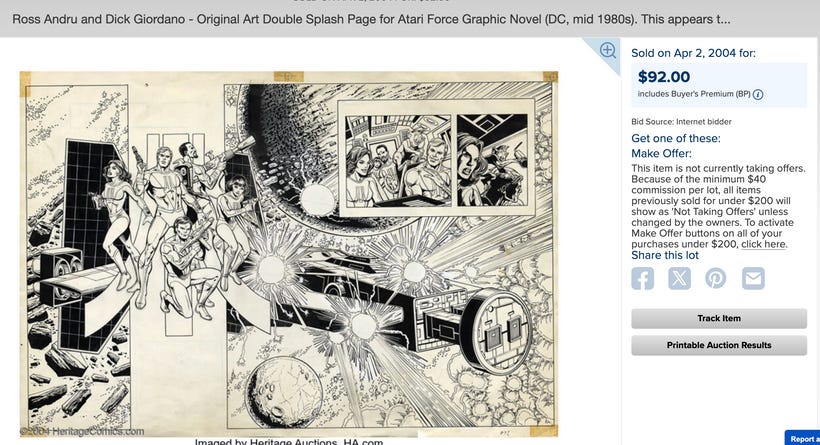
In 2004, this spectacular Ross Andru and Dick Giordano Atari Force double page spread went for an astonishing $92. Even adjusted for inflation, these prices are dead low.
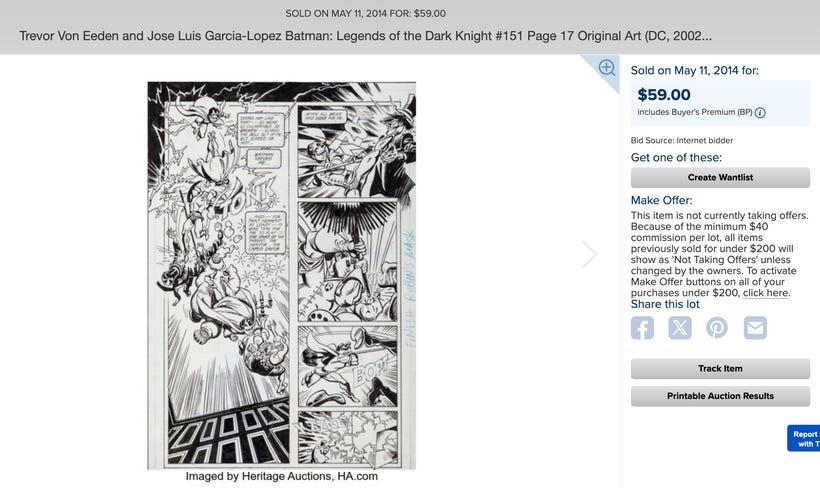
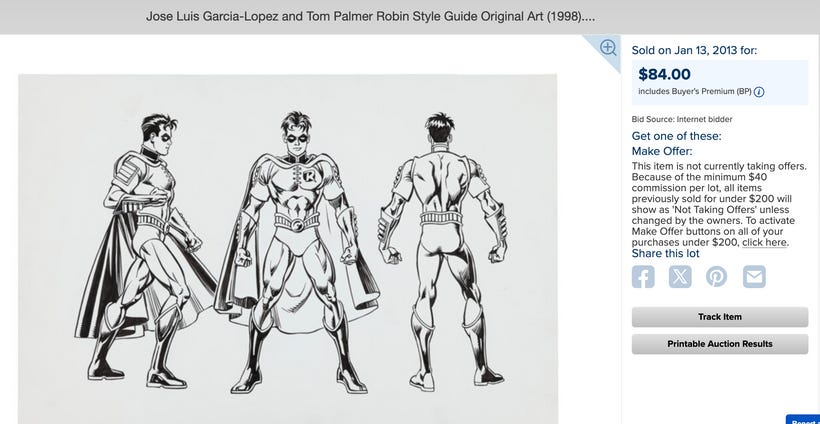
Trevor von Eeden (a personal favorite) and Garcia Lopez, only $59.
Style Guide art for a song.
Anyone want to make a guess at how much this GORGEOUS Poison Ivy Style Guide art would go for now?
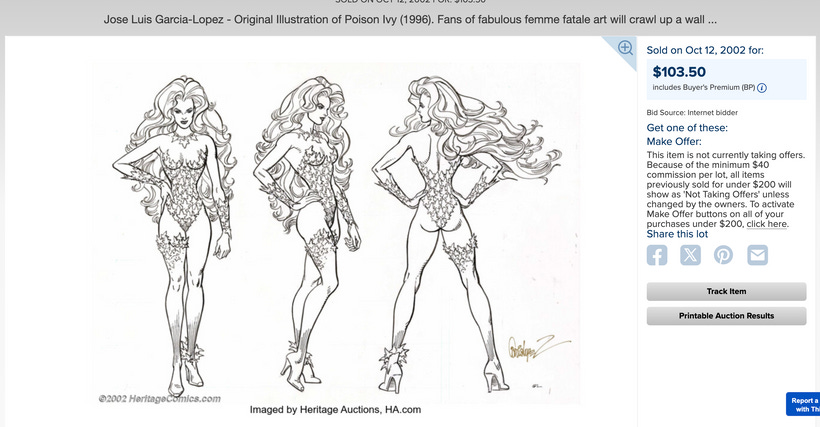
Yeah.
I wish I had a time machine.
I would buy my own art back then because prices were so low. I was kind of embarrassed about it, wondering if it was just me.
It wasn’t just me.
One of the most contentious and controversial discussions around What Money Was Then and Now surrounds the Siegel and Shuster sale of Superman.
The infamous sale check sold at auction for $160,000. The rights to Superman went for $130, and the final tally payment was for $412, which covered the page rate.
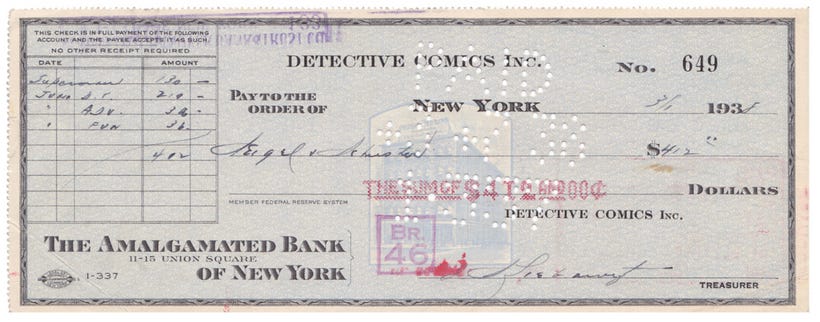
And today...
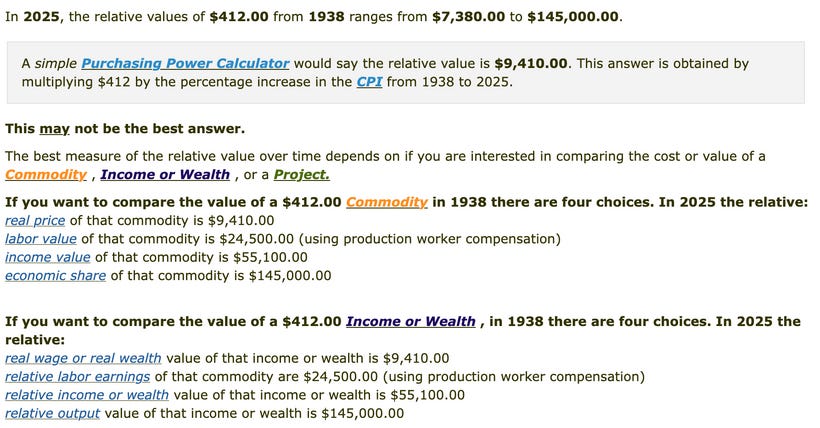
Their $10 a page rate was equivalent to:
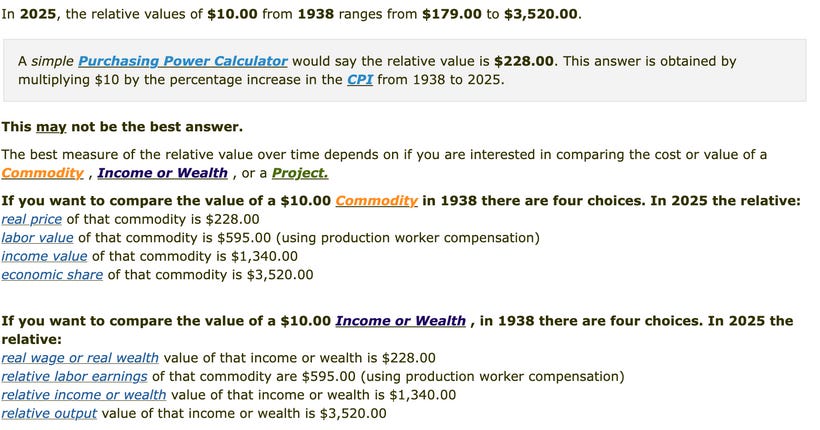
That was upped to $20 per page the following year.
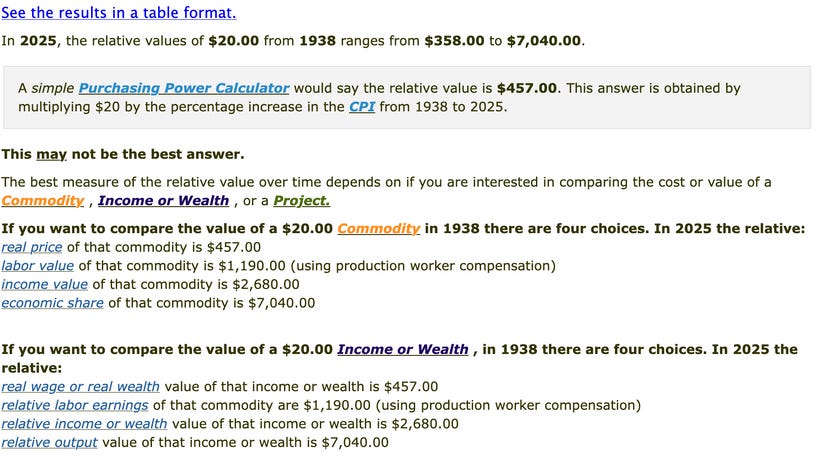
Now, that’s peanuts compared to what Superman ended up being worth. We get that.
But between 1938 and 1949, they were paid over $400,000 for their work and rights on Superman.
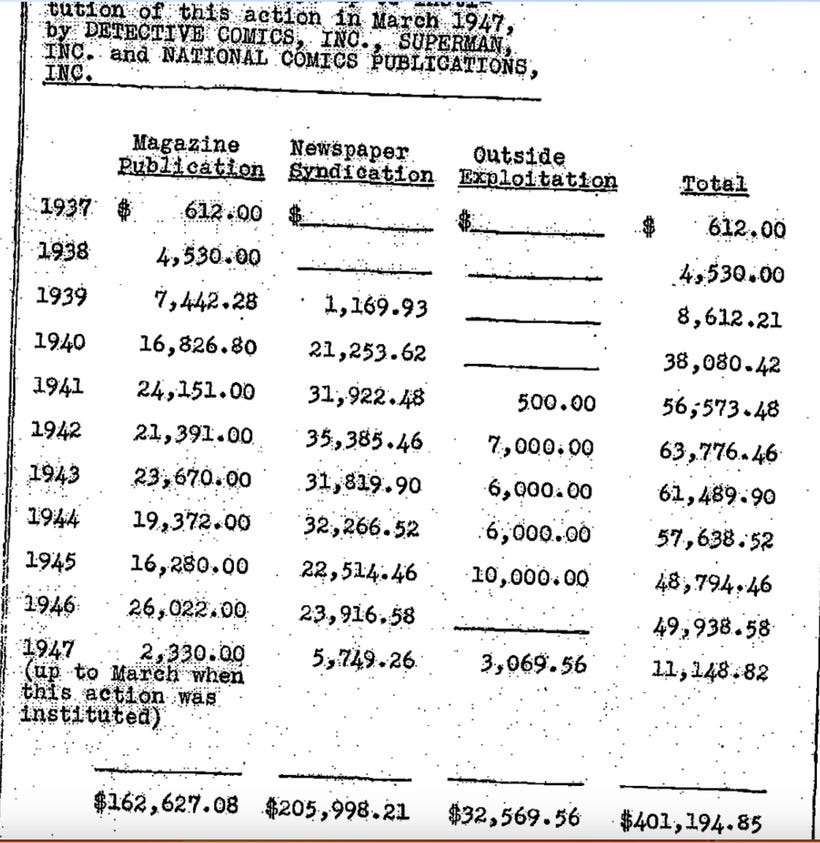
This is the rough equivalent.
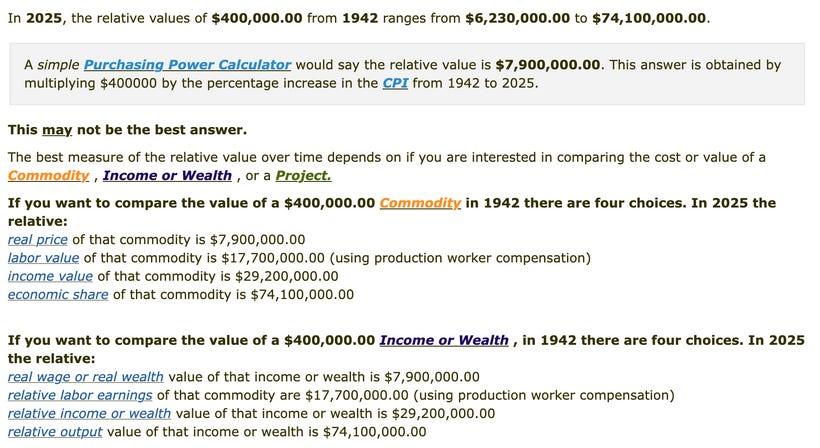
That’s...a lot.
What happened to the money? Well, who knows. We can make some educated guesses.
It was split between two people, they tried to start their own studio and had employees, and they must have been paying a pretty penny in taxes during the second World War. While in 1939 only a small percentage of the population paid income tax, by the end of the war, almost everyone was.
So again...everything is relative.
I don’t know how many employees they had. I do know they were notoriously bad at business. I’m glad DC Comics paid them a stipend in the end.
They made a bad deal because who the hell could possibly have known that Superman would grow into the modern mythology of the century? I can’t blame them for signing that deal.
I do give them sad noise for blowing through the equivalent of $7,000,000 in ten years, though.
I know other people who’ve done that, and it is kind of scary how fast it can happen. There’s a reason 30% of lottery winners declare bankruptcy.
Money management is a skill most people do not have, and before the internet, it was hard to invest.
After the internet, it’s even harder not to get ripped off.
There are times I’ve been very wise with every penny. There are times I’ve been incredibly stupid. There are times I’ve invested in projects that went belly up and took everything with them.
There are times when I’ve been happy and comfortable, and times when I bought nothing but chicken backs to eat.
There was the time I drove a near-30-year-old car that couldn’t go more than eight miles, and the time I got the very fine used luxury car at a great price that is now worth more than I paid for it because I take such good care of it.
Almost nothing is certain.
Money is not certain, jobs are not certain, reputations are not certain, the government is certainly not certain.
But one thing is certain.
The narratives about art and money almost always look at a number on a ledger while failing to accurately account for the meaning and context behind that number.
It takes money to finance certain kinds of art. Every minute you are making comic art, you need a roof over your head and tools.
I mean, if you can draw outside in the rain, good on you. But I can’t.
I’d be blind now if I hadn’t had the finances to pay for specialized care and experimental medicine. I’d probably be dead by now of cancer. I’m still paying some of those bills.
I’d be stuck in some pretty bad company if I didn’t have the resources to walk away.
You will always be judged as an artist, and it won’t always be because of what you produce.
You will be judged because of the narrative of what people think you are worth.
I’ve often heard it said that centrists are just cowards because they can’t pick a side. But who wants to be in the middle when both sides hate your guts? That’s not cowardice.
And being a middle class artist means you will get crap from people who think you are rich and you deserve nothing you have, and you will get crap from people who think you are too poor to bother with.
Why do you even need a Patreon? You must be rich.
Hi Ho.
Yours truly.
In the Middle.
c
Edited one date, should have been 2023 not 1993. Oops.
A great and educational piece. I've been broke most of my adult life, and only recently did I have a long-simmering deal finally hit and make me not-broke. I have savings for the first time in forever, and I'm still adapting to it, and trying not to be dumb about the little chunk of change I've ended up with (it's not even six figures, but it's a high five... which is very high for me.)
The (reasonable) fear that I'll blink and be back to worrying about the rent and the health insurance payment is too strong for me to enjoy the current moment as much as I'd like to.
I think of my dad, who grew up in the Depression. We had a period of relative wealth from the late sixties through the mid seventies, but when my mother would make a dinner that included a protein and a vegetable AND a salad, my father would wonder aloud what we were celebrating. What's the special occasion? (To be clear, he'd say this with pleasure not with judgement that my mom was being wasteful.) The trauma of his childhood set the bar on "wealthy" at "dinner which comes with a salad."
After forty plus years as a freelancer, I understand completely. My definition of comfort is "not doing math in the grocery store."